
Thought Leadership
The Restaurant Industry Has More Data Than Ever, But Less Clarity.
Why the AI investment in food service is going to the wrong layer

Tanvir Bhangoo
September 17, 2026
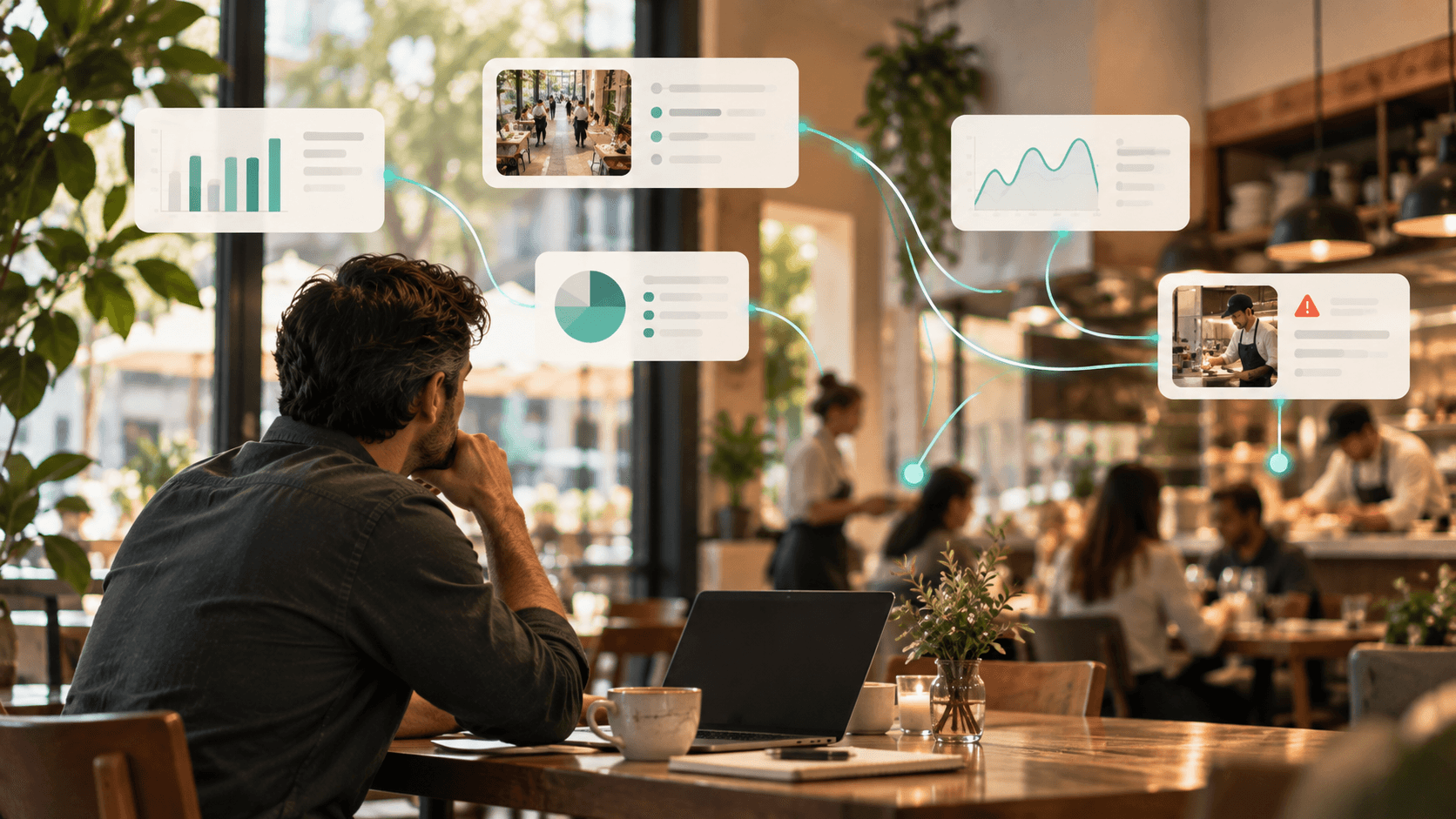
I was speaking with a friend who runs a 1,000+ store franchised brand.
He said that today, despite all the tools and integrations, he is unable to tell his GMs across each store the top three things they need to do daily to drive a great guest experience — and in turn grow top-line revenue and margins.
He's also unable to piece together the actual customer experience and speed of service across every touchpoint, or have a clear story behind what he needs to do next to grow the brand and franchise profitability.
The paradox
Walk the room at any major restaurant technology conference today and the conversation sounds optimistic. POS integrations have reached near-universal adoption across mid-market and enterprise brands. Labor management platforms track scheduling, actual hours, and cost variance in real time. Inventory systems flag waste and procurement signals at the item level. Third-party delivery platforms generate enormous datasets about order frequency, item performance, and guest behavior. AI vendors are announcing products every week.
And yet the most common thing I hear from COOs, CFOs, and franchisee owners is some version of: "We have too many tools, I'm not seeing the ROI, and I know we're leaving money on the table."
This isn't just the opinion of brand leaders who lack data. It's said by the most data-rich operators across segments.
The problem is that the data is not reaching the right person at the right moment in the right form to change what happens next.
The dashboard decade
The last ten years of restaurant technology investment followed a clear and logical trajectory. The industry needed to capture more data, so it built better tools, dashboards, and reporting.
Each of these investments was reasonable. Individually, each produced measurable value. And collectively, they created something that looks remarkably like clarity but functions more like an extremely detailed photograph of the recent past.
A photograph tells you what happened. It does not tell you what to do about it.
The BI dashboards and reporting tools that brands invested in were designed to answer the question: what happened? They were not designed — could not have been designed — to answer the question that operators actually need answered in real time: what should I do about it right now, before the shift ends?
The industry built very sophisticated rearview mirrors and called them intelligence. That is not a criticism of the companies that built them or the operators who bought them. It is an observation about what was technically possible, and what the market was ready to demand, at the time. The market is now ready to demand something different.
Side note: here's my recent industry-voice interview with Kelly MacPherson, where she shares her viewpoint on the future of analytics.

Industry Conversations
The Restaurant Intelligence Gap: Moving from Data to Action
The restaurant intelligence stack
To understand where the investment gap is, here is a high-level framework of what an intelligence stack needs to look like for operators to capture the value their data already contains.
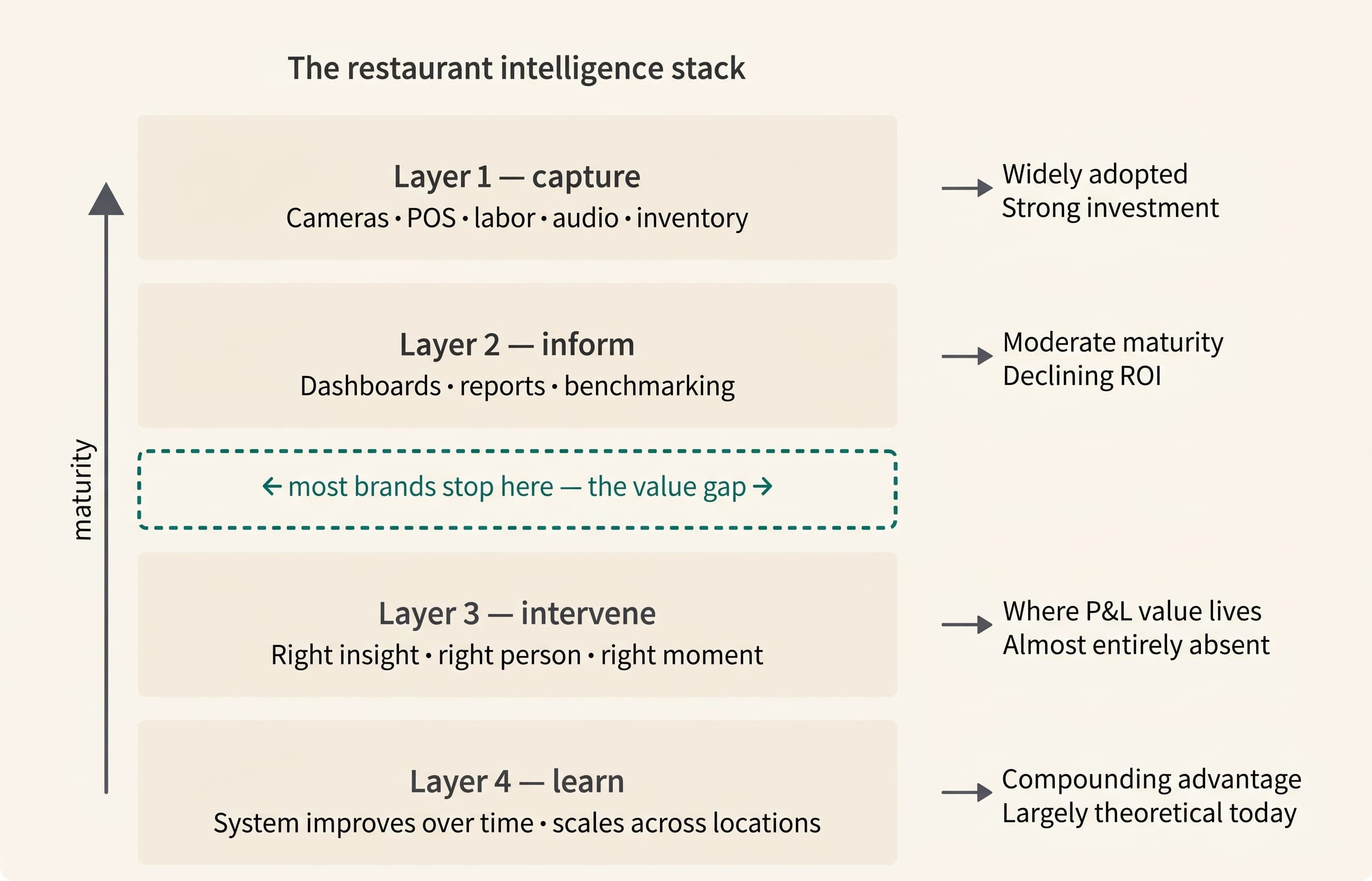
Layer 1 — Capture
The foundational layer. Data is collected from every touchpoint across different channels: POS, labor data, inventory movement, camera systems, app/web, and third-party platforms (although incompletely). Most mid-market and enterprise brands have strong capability here.
When I was leading tech at Freshii, we used to call this the 360-degree view of the customer, and every innovative executive was working toward getting this right.
Layer 2 — Inform
Data is organized, contextualized, and surfaced in a format a human can read. This is the dashboard layer: weekly reports, daily summaries, performance benchmarking against targets and peers. Most brands have reasonable capability here, though the quality varies significantly. This is the "what happened" layer.
Larger brands have done this well, with significant investment and time put into building and maintaining it. Most smaller mid-market brands I speak with are using third-party dashboards — from their POS provider or a consultant — that are incomplete, limited to that vendor's product, and hard to customize or maintain.
Layer 3 — Intervene
This is the layer that is almost entirely absent from today's restaurant technology landscape. Intervention means the right insight reaches the right person at the right moment for it to still be actionable — before the shift ends, before the guest leaves, before the margin is gone. This layer answers the question: what should I do about this right now?
It has to be tied directly to the store's and the brand's overarching goals, and it requires a strong analytical layer behind the scenes that can look at the operation in real time and surface what truly matters.
Layer 4 — Learn
The system gets better over time. Patterns identified at one location improve the model for all locations. Interventions that worked are reinforced; those that didn't are refined. This is the compounding layer, and for most brands, it remains largely theoretical.
Approximately ninety percent of restaurant technology investment today sits in Layers 1 and 2. The P&L value lives in Layer 3 and Layer 4.
The intervention window
In restaurant operations, value is either captured or permanently lost within a window measured in minutes, not hours. A missed upsell opportunity during the 11am–1pm lunch rush is gone the moment the guest pays and walks out. Labor overage that begins building at the start of a dinner shift cannot be recovered after payroll closes. A brand standard that breaks at a franchisee location at 7pm won't appear in a corporate report until next week — by which point it will have already repeated itself dozens of times.
The intervention window is the narrow period of time in which operational intelligence is still actionable. Once that window closes, the insight that could have changed an outcome becomes a historical data point that can only inform future behavior.
The operators who win in the next decade will not be the ones with the best data. They will be the ones who have closed the distance between insight and intervention until they are functionally the same thing.
What this means for operators and investors
This analysis has specific implications for how operators should think about their technology roadmap, and how investors should evaluate restaurant technology businesses.
For operators, the strategic question is no longer "how do we capture more data?" It's "how do we close the gap between what our data knows and what our operations do?" The answer sits at Layer 3 of the intelligence stack, and the brands that solve it first will be operating at a different level of growth and efficiency than those still investing in Layer 2 improvements.
For private equity and franchise brands specifically, the implications are multiplicative. A system that captures missed revenue at the unit level and eliminates labor waste at the shift level produces returns that compound across every location in the portfolio. A 1% check-size improvement across a 50-location brand is worth far more than 50 times that single-store gain, once it compounds across the system.
This is exactly what we are solving for at Meadow AI.
Meadow is an AI co-manager that analyzes the entire value chain across a location — customer experience, ordering, food prep, back of house, labor, compliance, and more — quantifies the gaps and opportunities, and proactively addresses them in real time.
Rather than simply giving operators another dashboard to check, Meadow works alongside teams throughout the day. It can flag something that needs attention, remind teams about important tasks, provide real-time coaching, answer questions, and automate repetitive operational work. In a busy restaurant or store, Meadow acts as an intelligent assistant that helps the team stay one step ahead.
By taking on more of the monitoring, analysis, and administrative work, Meadow gives managers and employees more time to focus on what matters most: their customers and delivering a great experience.
Meadow's clients have reported improved employee morale from the assistance Meadow provides, along with increased same-store sales and improved profitability, both at the individual location level and across the brand.
Key takeaways
Having data is not the same as having intelligence. Having intelligence is not the same as having action. Most restaurant technology today confuses the first for the third.
The intervention window — the narrow period in which operational insight is still actionable — closes within minutes in a restaurant environment. Most analytics systems generate insight days or weeks after that window has closed.
The next meaningful competitive advantage in restaurant operations is not a new data source. It is the speed at which insight becomes intervention.
Brands that rethink how they use these insights in real time, at scale, and rebuild their tech stacks around that will compound in ways that are attractive to franchisees and investors — and structurally difficult for competitors to replicate.
Get in touch
Tanvir Bhangoo, CRO — sales@meadow.ai
See what an AI co-manager would find in your stores.
We'll walk your operation through where Meadow drives measurable revenue, margin, and execution gains.