
Industry Conversations
Building a Global Brand, Understanding the Guest and Putting AI to Work
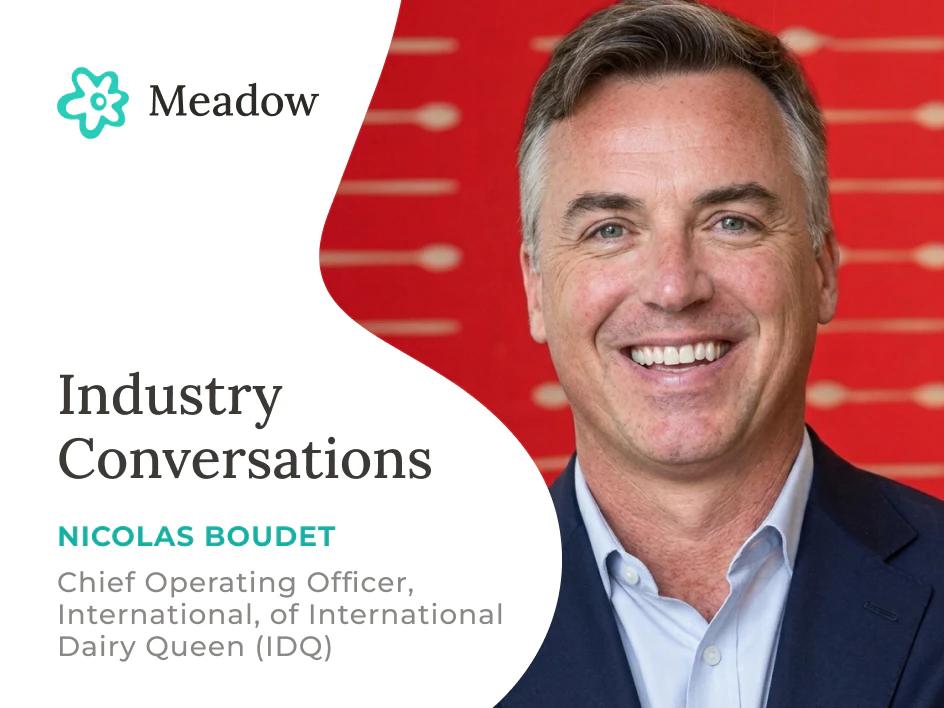
A conversation with Nicolas Boudet, Chief Operating Officer, International, of International Dairy Queen (IDQ).

November 16, 2026
You oversee Dairy Queen's international business across very different markets, cultures, and franchise partners. What's one thing that surprises people about running a brand like DQ outside the U.S., and what has stayed constant everywhere?
NB: Dairy Queen has been around for 86 years, and in the U.S., it's deeply ingrained in people's memories. Think of a small-town Friday night after a game, with a Dilly Bar in the back seat. That nostalgia is a big part of what the brand represents here.
Internationally, it's a different story. We've operated outside the U.S. for more than 70 years, starting with Canada and then expanding into Panama and other markets. Canada, Panama, and, to some extent, Mexico have that same multigenerational connection. But most of our other markets are much younger.
A 16-year-old in Bangkok or Monterrey doesn't necessarily have a childhood memory of Dairy Queen yet. We're creating those memories one visit at a time. In the U.S., we're selling nostalgia and a familiar feeling. Internationally, people judge us on the product and the experience in front of them. It's the same logo with a different job.
In China, for example, we have more than 2,000 stores, and we're positioned as a premium, affordable treat. In Mexico, we're competing with local paleterias on every corner. The markets are very different, but what stays constant is the Blizzard flip. Turn a Blizzard upside down in Shanghai, Panama City, or Manila, and you get the same grin and the same moment of joy.
Consumers are trading down, traffic is soft in many categories, and costs for labor, food, and rent remain elevated. How are you seeing that play out across your major markets, and where do you think the industry is still misreading the consumer?
NB: To me, transactions are the truth of our business. Price can carry comparable sales, but traffic is the great leveler. We've seen brands report positive same-store sales because of pricing, while guest counts continue to decline.
Transactions are the truth of our business. Price can carry comparable sales, but traffic is the great leveler.
The pressure is being felt across markets, although it shows up differently in each one. In the U.S., fast-food traffic was down approximately 2.6% in Q3, according to RMS. In China, for example, the value war is particularly intense, with tea and ice cream players competing at price points that are difficult to match.
I think the industry makes two mistakes when interpreting consumer behavior. First, we confuse value with price. Value is what you get divided by what you pay. And what you get includes speed, a clean store, a smile, and a product worth sharing. It's the entire experience, not just the price on the menu.
The second mistake is assuming that consumers who are trading down stop indulging altogether. That's not what we're seeing. People may cut back on a major purchase, but they still protect the small treats. We're seeing consumers continue to spend on specialty beverages and other affordable indulgences. People are very rational about how they treat themselves.
Which of those pressures do franchisees feel first?
NB: It's really about margin. Franchisees feel the pressure in the middle of the profit and loss (P&L) before they necessarily see it at the top line.
Rent and fixed labor costs don't flex when traffic drops by two percentage points. When you lose transactions, the impact on profitability can happen very quickly.
Internationally, currency adds another layer of complexity. Key inputs are often imported and priced in U.S. dollars. When the local currency weakens, food costs increase before a single guest changes their behavior.
That pressure ultimately affects the franchisee's ability to reinvest in the business. It's not necessarily a lack of willingness to remodel or improve the restaurant. It's the cash flow and the ability to fund those investments.
In a system where most restaurants are run by franchisees, what's the hardest gap between what leadership thinks is happening in the restaurants and what's actually happening on a given Saturday at 2 p.m.?
NB: The report we receive at head office and what the guest actually experiences are two very different things.
When you're managing thousands of stores, you generate a tremendous amount of key performance indicators (KPIs). But averages can be misleading. A store can have a great month that hides a terrible weekend, and it's easy to become comfortable with the average.
The real question is what's happening on the floor at 2 p.m. on a Saturday. Did the 19-year-old at the counter greet the family? Is the Blizzard machine down? Is the lobby clean? Is the manager on the floor or in the back doing paperwork?
Another issue is that when numbers reach the store, they often arrive without the context behind them. I once sat with a store manager whose only response to a sales miss was that the team needed to upsell more. But nobody had explained whether the problem was fewer guests or smaller tickets. Those require completely different solutions.
The brilliance is in the field, not at the head office. That's why I track every market visit and maintain a commitment register after each one. What we agree on in the field needs to translate into action. It can't simply disappear once everyone gets back on a plane.
The brilliance is in the field, not at the head office.
Every operator has more dashboards and reports than ever. Is the problem a lack of data, or getting the right insight to the right person at the right moment?
NB: I don't think we're short on data. I think we're short on timing and translation.
A report often arrives after the decision window has closed. A dashboard can tell you what happened last month, but by then, you may no longer be able to change the outcome. Insight needs to explain what happened, why it happened, who needs to act, and by when.
I have three tests that I apply to any report: Who is the person? What's the decision? And what's the timing window?
A shift lead needs information before the rush. A district manager needs it before setting the Friday labor schedule. A franchisee needs it before the next pricing decision. If a report can't identify the decision it's meant to support, I would question whether it needs to exist.
We sometimes have situations where the data itself is correct, but the interpretation is wrong. For example, we had planned around Chinese New Year in February, while the operating calendar placed the holiday week in March. February looked like a miss, and March looked like a beat. We spent weeks explaining a gap that wasn't real. It was simply a calendar issue.
The goal shouldn't be to show more year-over-year variance. It should be to give someone information they can actually use to make a better decision.
When you think about the role of an AI layer in restaurant operations, not just reporting, but something that's actually monitoring, identifying, and driving action in real time, what does that look like practically? And what does it need to get right to earn the trust of operators?
NB: The ultimate test is pretty simple: Does the store manager want to keep it switched on, or do they want to unplug it?
Does the store manager want to keep it switched on, or do they want to unplug it?
Practically, I see it working in three loops. The first is to watch. It notices what a great district manager would notice if they could stand in 400 stores at once: line length, an un-greeted guest, a station that's down or a dirty lobby during peak hours.
The second is to flag. It tells the person who can fix the problem, in real time and in their language, one thing at a time.
The third is to close the loop. It checks whether the fix happened and learns which alerts actually matter.
To earn trust and daily adoption, there are a few things AI needs to get right.
First, precision over volume. If a manager receives ten false alarms in the first week, they'll mute the system forever.
Second, it needs to talk to the store before it talks to corporate. If the first person to hear about a dirty lobby is someone in Dallas, it starts to feel like surveillance. If the shift lead receives that information and has the opportunity to correct the issue, it's genuinely useful.
Third, it needs to be specific. Telling someone that six guests have waited eight minutes while only two registers are open is much more useful than showing a red light on a dashboard.
Fourth, it has to respect local legislation. Camera and audio rules, employee consent, and where data can be stored or transferred vary significantly across markets, including Mexico, China, the Gulf, and Southeast Asia.
Finally, in a franchise system, the franchisee owns the store, the cameras and the employment relationship. If they don't see the value in their own P&L, adoption stops at the pilot stage. That's where many tools fail. There are plenty of pilots, but very few make it to widespread adoption.
Where would you start when it comes to AI, and how would you work toward real, quantifiable return on investment (ROI)?
NB: I would start with one problem that is already costing the business money and is easy to measure. It could be peak-hour throughput or labor deployment against traffic. Pick one problem, one metric and establish a baseline before switching anything on.
Then run a controlled test. Ideally, that means at least 20 test stores compared with 20 matched control stores over 90 days. You need enough consistency to understand whether the technology actually made a difference.
There's also a franchisee consideration that technology vendors sometimes miss. In a franchise system, the franchisor may only capture a portion of the financial benefit through royalties. The ROI case has to work in the franchisee's P&L, not just the franchisor's. If the franchisee doesn't see the payback, they won't renew, regardless of what the presentation says.
I'd also caution against what I call the pilot trap. Companies often choose their best-run stores and strongest managers for a pilot. The results look great, but when you try to scale the technology, the results disappear because you haven't tested it in the locations where the challenges are greatest.
You need a representative mix of stores, including the ones you're worried about. That's how you determine whether something can work across the actual business, not just in ideal conditions.
If you were advising a chief operating officer (COO), chief financial officer (CFO), or investor evaluating a restaurant brand today, what's the one operational signal you'd want to see in real time, and what decision would it change?
NB: I'd stay consistent with what I've said throughout this conversation: transactions. I want to see guest transactions by daypart, by store, every day. Not just sales.
Comparable sales can look healthy because of higher prices, even while guest counts decline. A brand can post positive comparable sales for two years while losing guests every week.
Guest count by daypart, compared with the same week last year, tells me whether the brand is actually earning visits. Visits are the lifeline of our business.
That information should shape decisions around pricing, bundling, local store marketing, and labor allocation.
The simplest way I can put it is this: A brand growing its guest count has pricing power in reserve. A brand growing only its average ticket has already spent it.
A brand growing its guest count has pricing power in reserve. A brand growing only its average ticket has already spent it.
Dairy Queen has a significant international footprint, but many people may not realize just how large the business has become. What's next for DQ International, and what opportunities are you focused on?
NB: Dairy Queen is an 86-year-old brand owned by Berkshire Hathaway, with more than 8,000 stores across 22 markets. We've publicly shared our ambition to reach $10 billion in system sales by 2030.
We're continuing to open new markets. We entered Taiwan less than two years ago, and we're expanding into Hong Kong and Macau. We also have a significant business in China, where we've operated since 1992 and surpassed 2,000 stores this year.
We're very proud of that growth. Dairy Queen is alive and kicking globally, and despite the macroeconomic challenges, we're positive about the outlook and how the brand resonates with consumers around the world.
We're always looking for strong partners and operators to help us continue expanding internationally. There's still a lot of opportunity ahead.

Nicolas Boudet
Chief Operating Officer, International
International Dairy Queen
Nicolas Boudet is Chief Operating Officer of International Dairy Queen (IDQ), a wholly owned subsidiary of Berkshire Hathaway. He runs IDQ's international business with more than 3,000 restaurants across 22 countries outside the U.S. and Canada.
Nicolas joined IDQ in 2022 from Wingstop, where he served as President of International and Senior Vice President of Global Development. Before that, he was Executive Vice President and Group President of International at Focus Brands, now GoTo Foods, where he led Auntie Anne's, Carvel and Cinnabon, among other brands. Earlier, at YUM! Brands, he headed franchising and development for Taco Bell U.S. and served as Chief Development Officer for Latin America and the Caribbean across KFC, Pizza Hut and Taco Bell.
Nicolas began his career in real estate investment and development at Jones Lang LaSalle, Club Med and Starwood Hotels and Resorts before moving into restaurants. He holds a master's degree from ESSEC Business School in Paris, France.
See what an AI co-manager would find in your stores.
We'll walk your operation through where Meadow drives measurable revenue, margin, and execution gains.